
Trending
Blockchain’s Impact on Physical Infrastructure Across Industries
Blockchain’s Impact on Physical Infrastructure Across Industries
Decentralized Physical Infrastructure Networks (DePIN) are emerging as a transformative force in the management of real-world systems by leveraging blockchain technology. These networks offer the potential for more efficient, transparent, and user-driven infrastructure management across a variety of sectors, including energy, telecommunications, transportation, and artificial intelligence. Currently valued at $50 billion, the DePIN market is projected to reach the trillion-dollar threshold within the next three years, underscoring the growing recognition of blockchain’s capacity to reshape global infrastructure.
Challenges and Innovations in DePIN Adoption
Navigating the Blockchain Trilemma and Integration Complexities
A fundamental obstacle to the widespread adoption of DePIN lies in the blockchain trilemma—the challenge of simultaneously achieving scalability, decentralization, and security. Physical infrastructure applications demand high transaction throughput and robust security measures, yet maintaining decentralization under these conditions remains a complex task. Additionally, integrating blockchain solutions with existing infrastructure often entails significant financial and technical burdens. This complexity has fueled skepticism in the market about blockchain’s ability to efficiently manage large-scale physical systems.
Further complicating adoption are fragmented protocols, user interfaces that lack intuitiveness, and the absence of standardized data exchange mechanisms. Regulatory compliance and cybersecurity concerns are particularly pressing, especially as the global cybersecurity infrastructure market, currently valued at approximately $190 billion, expands in response to escalating cyber threats and tightening regulations. In response, industry players are either developing proprietary blockchain platforms or forming strategic partnerships with blockchain providers to enhance their infrastructure capabilities.
To address these challenges, innovative technical solutions are being introduced. Modular subnet architectures and Directed Acyclic Graph (DAG) structures are among the advancements designed to improve scalability without compromising decentralization. These developments are critical to enabling broader adoption and operational effectiveness of DePIN systems.
Vietnam’s Strategic Approach to Blockchain Integration
Vietnam is positioning itself at the forefront of blockchain adoption, particularly in the DePIN space. The country’s recently enacted Law on Digital Technology Industry underscores a commitment to integrating blockchain technology into national infrastructure. This legislative framework aims to foster innovation while ensuring regulatory compliance, offering a potential model for other nations seeking to harness the transformative potential of DePIN.
U2U Network: A Case Study in Scalable DePIN Infrastructure
The U2U Network exemplifies cutting-edge innovation within the DePIN ecosystem. As a layer-1 blockchain specifically designed for DePIN applications, U2U achieves transaction speeds of up to 17,000 transactions per second and employs a modular subnet architecture that supports scalability and customization. The network hosts over 40 active DePIN projects, including U2DPN—a decentralized private network comprising 89,000 contributor nodes and facilitating 84 million sessions. Through these capabilities, U2U is setting new benchmarks for efficiency and scalability in decentralized infrastructure systems.
DePIN Applications Across Key Industries
In the energy sector, DePIN is driving a revolution through decentralized grids such as virtual power plants and microgrids. These systems empower users to own power generation assets, enhance grid resilience, and reduce reliance on centralized utilities. Telecommunications is witnessing a democratization of connectivity via decentralized networks pioneered by initiatives like Helium, which extend coverage for Internet of Things (IoT) devices and are expanding into 5G, thereby lowering costs and improving reliability.
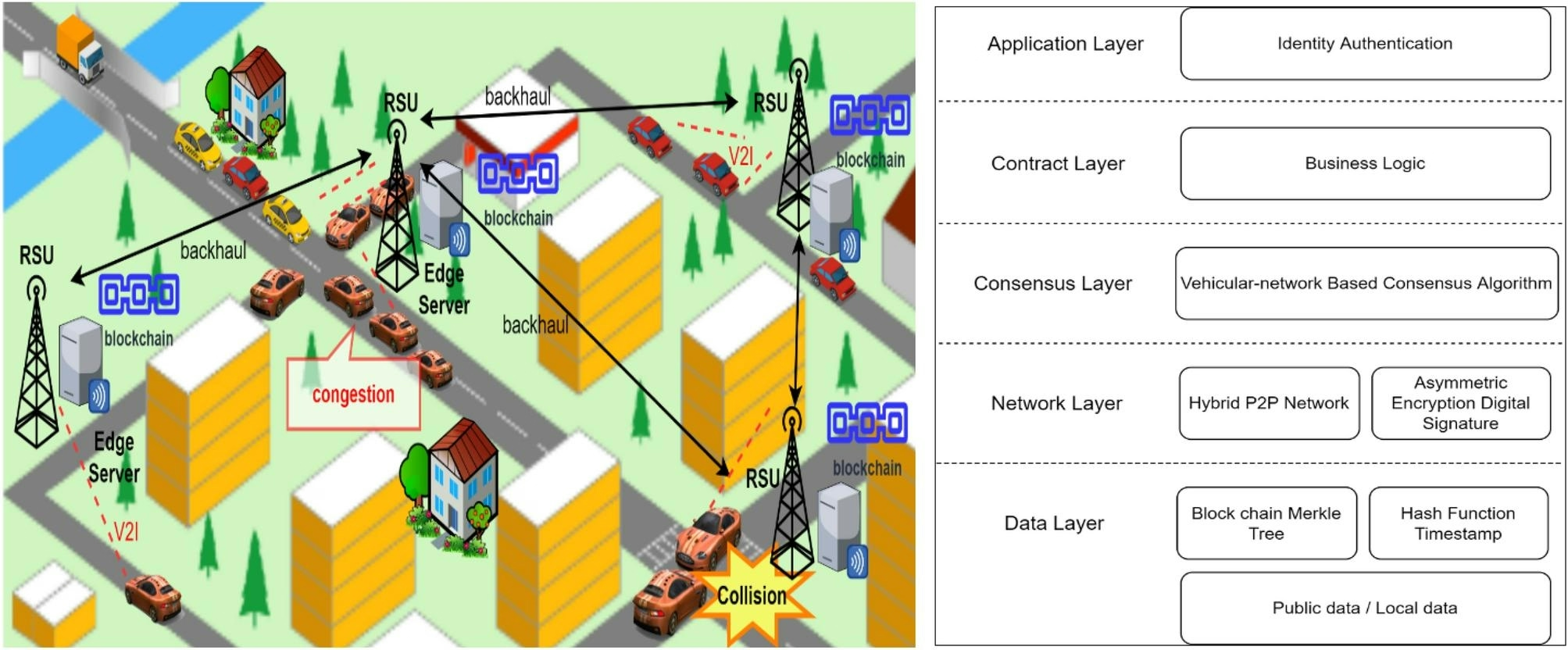
Within transportation, DePIN supports decentralized ridesharing and mapping services that eliminate intermediaries, resulting in fairer pricing and more accurate geospatial data. In the field of artificial intelligence, DePIN facilitates the aggregation of unused computing resources into decentralized marketplaces, democratizing access to AI training infrastructure and reducing dependence on centralized providers.
Outlook
Despite the significant promise of DePIN, its widespread adoption depends on overcoming persistent challenges related to integration, scalability, regulatory compliance, and cybersecurity. As blockchain technology continues to advance and regulatory frameworks evolve, DePIN is poised to assume a pivotal role in shaping the future of global physical infrastructure.