
Trending
Solana Founder Sparks Debate Over Decentralization
Solana Founder Sparks Debate Over Decentralization
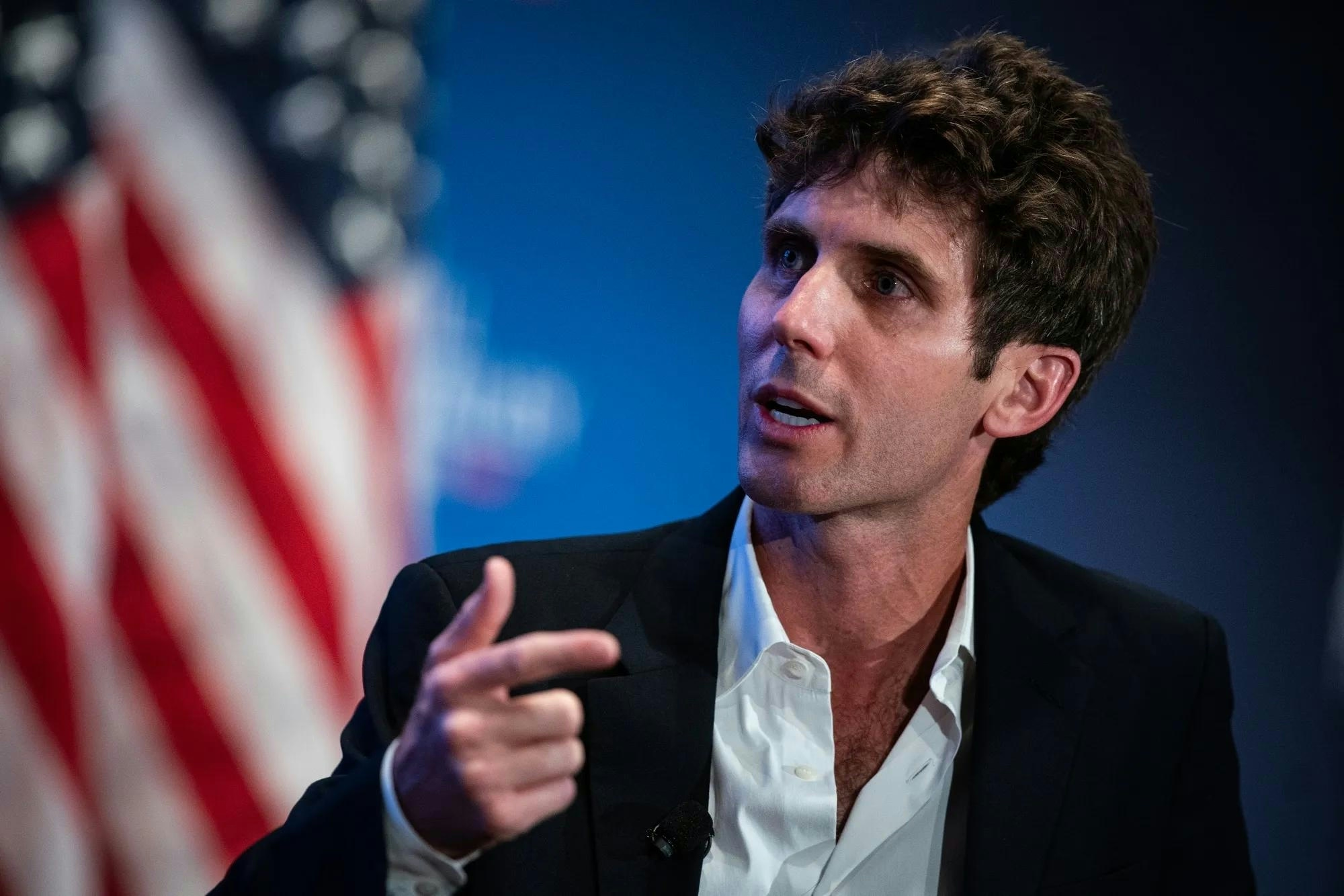
Anatoly Yakovenko, co-founder of Solana Labs, has reignited a contentious debate surrounding blockchain decentralization following a statement posted on X (formerly Twitter) on June 14. Yakovenko asserted that “all users need is 1 full node to defend against 100 percent of malicious stake,” arguing that any node—even one without SOL staked—could effectively “carry the torch” and veto a rogue software upgrade. This claim is grounded in Solana’s fork-choice rules, which allow honest clients to reject invalid blocks.
The comment quickly became a focal point in the ongoing rivalry between the Solana and Ethereum communities. Critics interpreted Yakovenko’s remarks as an indication that Solana’s high-speed performance depends more on social coordination than on a robust, hard-coded decentralization framework.
Centralization Concerns Surface
Among the first to respond was developer “0xZodomo,” who cautioned that “a single Discord channel is capable of making sweeping changes to Solana consensus,” accusing proponents of effectively marketing centralization as a feature. Legal expert Gabriel Shapiro, known as @lex_node, derided the concept of a one-node chain, coining the term “gorbagana.” Ethereum advocate “Etheraider” pointed to Solana’s history of network outages—seven documented halts since 2020—as evidence that the platform’s resilience claims are overstated.
Yakovenko, often referred to as “toly,” defended his position by emphasizing that fee stability, rather than perfect uptime, is the primary concern for most users. He stated, “No fee spikes,” underscoring that predictable transaction costs matter more to retail participants than occasional block-time delays cited by enterprise critics. He further contrasted Solana’s throughput with the narrow operational margins of traditional financial infrastructure, asserting, “What I care about is assets that move.”
Supporters within the Solana ecosystem echoed this emphasis on performance. Mert Mumtaz, CEO of Helius, highlighted that Solana “handles more scale than all other blockchains combined, has the highest-revenue apps, and is about to get 100× faster while doubling block-space,” referencing the forthcoming Firedancer client and the introduction of pipelined fee markets.
Decentralization Metrics and Market Context
Despite these defenses, questions about Solana’s decentralization remain unresolved. Validators.app reports that Solana currently operates approximately 1,400 consensus validators and 5,170 total nodes distributed across 46 countries. This figure exceeds the 1,295 “high-quality” validators cited in the Solana Foundation’s June report but falls short of Yakovenko’s own estimate of 6,000 nodes. By comparison, Ethereum supports 11,841 reachable full nodes and roughly 1.04 million validator entities securing its proof-of-stake consensus, according to data from Etherscan and the Beacon Chain.
Solana’s history of network outages continues to influence perceptions of its decentralization. Although the network has not experienced a hard halt since February 2024—when a bug froze block production for five hours—previous incidents, often triggered by client bugs or transaction-spam attacks, have necessitated off-chain coordination among validators to restore operations. Critics argue that this dependence on social coordination exposes a potential vulnerability, while Yakovenko maintains that such a social layer ultimately serves to protect users.
Broader Industry Implications
The debate over decentralization is not unique to Solana but reflects broader tensions within the cryptocurrency sector. Discussions frequently revolve around the balance between network security, scalability, and governance models. Market reactions to these debates can be volatile, with investor sentiment shifting in response to perceived strengths or weaknesses in a network’s architecture. Competitors such as Ethereum often emphasize their own decentralization credentials in response to controversies, aiming to reassure users and investors of their networks’ resilience.
As this discourse unfolds, the interplay between speed, stability, and decentralization remains central to the evolution of Solana and the wider blockchain industry.